
MSME Opportunities in Uttar Pradesh: Sectors Driving Growth in 2026
How Uttar Pradesh is building an ecosystem where MSMEs are driving manufacturing, innovation and industrial growth
As India’s manufacturing landscape evolves, Micro, Small and Medium Enterprises (MSMEs) are playing a more significant role than ever. MSMEs account for a substantial share of the country’s manufacturing output, exports and employment, while strengthening domestic supply chains and entrepreneurship.
Traditionally known for its manufacturing heritage, from Banarasi silk and Lucknow’s Chikankari to Kanpur’s leather industry, the state is now building a more diversified industrial base that combines these traditional strengths with modern manufacturing, advanced infrastructure and sector-focused policies.
Improved connectivity, dedicated industrial corridors and an expanding manufacturing footprint have positioned the state as an attractive destination for enterprises seeking to establish or scale operations, giving MSMEs access to larger markets, stronger supply chains and a bigger role in India’s evolving industrial economy.
Building an ecosystem for MSME growth in Uttar Pradesh
With nearly 96 lakh+ MSMEs, Uttar Pradesh has one of the largest enterprise bases in the country, accounting for around 14.2% of India’s total MSME count.
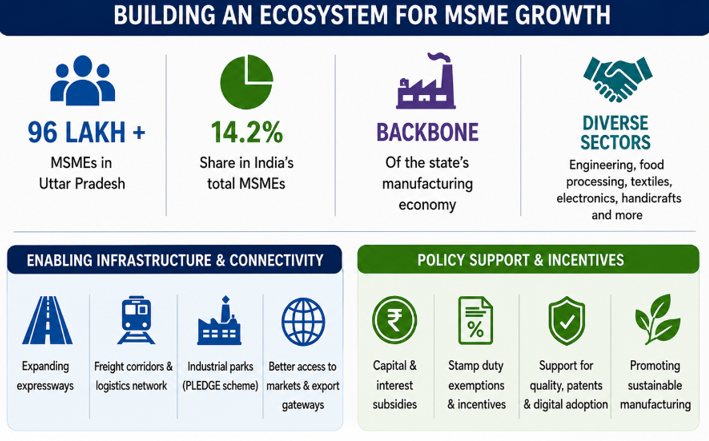
The state’s approach has evolved from financial assistance alone toward building a multi-modal connectivity system with better infrastructure, market access, policy support and stronger industrial linkages. An expanding network of expressways, freight corridors and logistics infrastructure is improving access between manufacturing centres, consumption markets and export gateways.
Industrial parks developed under the Promoting Leadership and Enterprise for Development of Growth Engines (PLEDGE) scheme is being backed by a Rs 2,500 crore revolving corpus. These are creating integrated spaces where manufacturers, suppliers and service providers can operate side by side.
Uttar Pradesh Micro, Small & Medium Enterprises Promotion Policy 2022
| Feature | Policy Details |
| Capital Subsidy | Up to 25% capital subsidy depending on the region (capped at ₹4 crore). |
| Interest Subsidy | Up to 50% annual interest subsidy (up to ₹25 lakh) for 5 years. This increases to 60% for SC/ST and women entrepreneurs. |
| Stamp Duty Exemption | Up to 100% exemption in Purvanchal and Bundelkhand; 75% in Madhyanchal and Paschimanchal. Women entrepreneurs receive 100% exemption anywhere in the state. |
| Infrastructure Support | Up to 50% infrastructure interest subsidy for 7 years for approved MSME industrial parks. |
Capital subsidies, interest subsidies, stamp duty exemptions and infrastructure incentives, combined with improvements in the state’s Ease of Doing Business framework, have further strengthened the broader investment ecosystem for enterprise growth. Under the Uttar Pradesh Micro, Small & Medium Enterprises Promotion Policy 2022, eligible MSMEs also receive support for quality certifications, patents, digital technology adoption and environmentally sustainable manufacturing practices, helping enterprises improve competitiveness alongside capacity expansion.
Uttar Pradesh MSME sectors driving growth in 2026
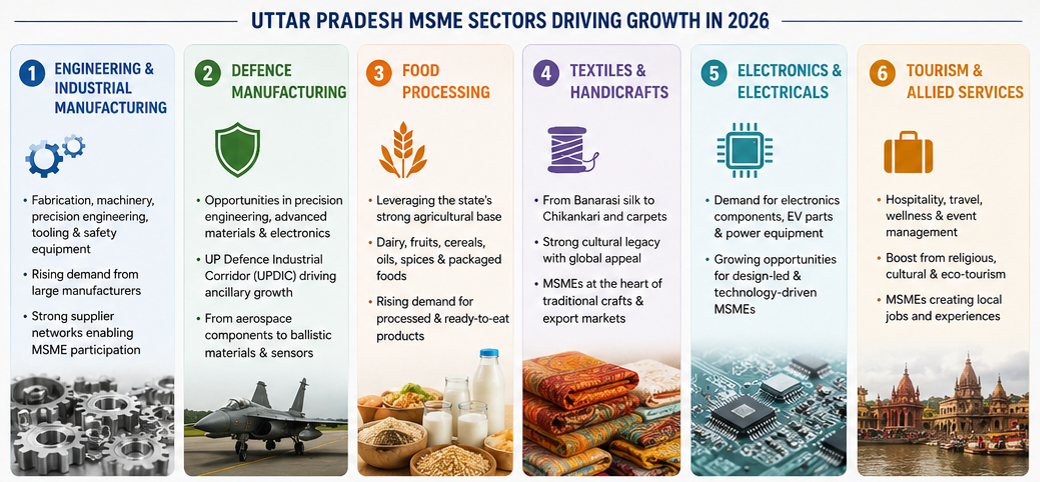
Today, several Uttar Pradesh MSME sectors are benefiting from changing market dynamics, stronger infrastructure and deeper integration with national and global value chains.
- Engineering and industrial manufacturing is among the strongest MSME opportunities in Uttar Pradesh, with enterprises in fabrication, industrial machinery, precision engineering, tooling and industrial safety equipment seeing rising demand from larger manufacturers.
As major companies expand production across the state, they increasingly rely on networks to supply components, fabricated assemblies and industrial services. Established names such Chopra Retec Rubber Products Ltd., ColorJet Group and Karam illustrate the breadth of this ecosystem, with a wider base of component manufacturers and service providers built up around them.
- Defence manufacturing is opening up a distinct set of opportunities for specialised MSMEs. While much of the attention on the UP Defence Industrial Corridor (UPDIC) has focused on large Original Equipment Manufacturer (OEM) investments, the corridor’s longer-term significance lies equally in the ancillary industries growing around them.
In Lucknow, Aerolloy Technologies manufactures titanium castings for aerospace engines and missiles, while Aligarh-based Nitya Creations focuses on precision-machined components and arms sub-assemblies. Kanpur has emerged as a defence materials hub, with A R Polymers producing ballistic materials, Adhunik Materials and Sciences making defence textiles and armour fabrics, and Datum Advanced Composites supplying carbon-fibre components for aerospace and unmanned platforms.
In electronics, Amitec Electronics supplies electronic warfare sub-systems, together, these enterprises push the corridor’s MSME opportunity into precision engineering, advanced materials and electronics.
- Food processing is helping the state add greater value to its considerable agricultural base. As India’s largest producer of several agricultural commodities, Uttar Pradesh gives food processors ready access to raw materials, and MSMEs are active across dairy, fruit processing, cereals, edible oils, spices and packaged foods. Rising demand for processed and ready-to-eat products, along with improving cold-chain infrastructure, is pushing businesses toward higher-value manufacturing, with processed food remaining one of the state’s leading export categories.
- Textiles, apparel and heritage industries continue to anchor the state’s traditional manufacturing strength. Cities such as Varanasi, Lucknow, Bhadohi, Moradabad, Meerut and Saharanpur have built global recognition through Banarasi silk, chikankari embroidery, carpets, brassware, sports goods and woodcraft and are industries that support thousands of MSMEs. What’s changing is how these businesses operate: greater e-commerce participation, better branding and export-focused production are helping many reach new markets.
This transition is further supported by the Uttar Pradesh Textile and Garmenting Policy 2022, which encourages investment through capital and infrastructure support while promoting integrated textile parks, skill development and export-oriented manufacturing.
Uttar Pradesh Textile and Garmenting Policy 2022
| Feature | Policy Details |
| Capital Subsidy | Up to 25% capital subsidy on plant and machinery for units generating employment for at least 50 people. Units in Purvanchal and Bundelkhand receive an additional 10% subsidy. |
| Land Cost Subsidy | Up to 25% reimbursement on land purchased from Government Authorities |
| Stamp Duty Exemption | Up to 100% exemption on land purchased or leased from Government Authorities. Also provides up to 100% exemption for developers of PM MITRA Park and private textile parks. |
| Electricity Relief | Up to 100% exemption from Electricity Duty for new units for 10 years. |
- The leather and footwear industry, centred around Kanpur and Agra, remains one of the state’s most established manufacturing sectors.
Uttar Pradesh Footwear, Leather and Non-Leather Area Development Policy 2025
| Feature | Policy Details |
| Capital/Land Subsidy | Single units receive up to 25% land subsidy in Pashchimanchal and 35% elsewhere. For clusters and mega anchor units, the subsidy increases to 75% in Pashchimanchal and 80% in other regions |
| Electricity & Transport | Subsidy of ₹2 per unit on electricity charges for 5 years along with up to 75% subsidy on transport and logistics. |
| R&D & Training | Grant of ₹1 crore for patent and copyright expenses under R&D, along with up to 30% subsidy on technical courses related to the leather and footwear sector. |
To build on this strength, the Uttar Pradesh Footwear, Leather, and Non-Leather Area Development Policy 2025 plans to support the state’s share in leather and non-leather export, upgrade technology to modernise production facilities, and upskill youth. The upcoming Uttar Pradesh Leather and Footwear Policy aim to double the size of the state’s industry in five years, targeting massive export expansions to global markets.
- Technology and electronics are steadily expanding the MSME landscape. Noida, Greater Noida and Lucknow have seen growing activity in software development, IT-enabled services, automation and electronics manufacturing support, while the broader digital transformation of manufacturing, automation, smart manufacturing, digital quality systems, is generating fresh demand for MSMEs offering specialised software and engineering services.
One District One Product 2.0 (ODOP): Strengthening Local Industries
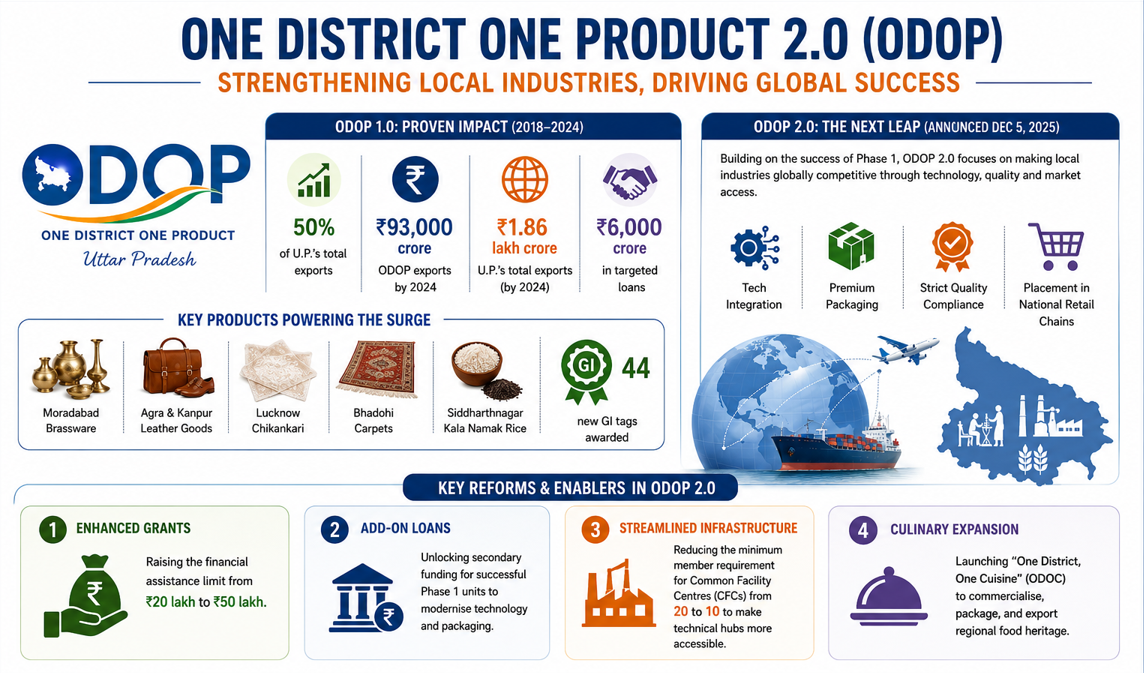
Launched in January 2018, the original One District, One Product (ODOP) initiative transformed Uttar Pradesh’s MSME landscape. By 2024, it drove 50% of the state’s total exports—generating Rs 93,000 crore out of a record Rs 1.86 lakh crore. Backed by Rs 6,000 crore in approved projects under the ODOP Margin Money Scheme and 44 GI tags, the program was a massive commercial success.
Capitalising on this momentum, the UP government announced ODOP 2.0 on December 5, 2025. While Phase 1 focused on grassroots revival, Phase 2.0 pivots to global competitiveness. The goal is to elevate local industries through technology integration, premium packaging, strict quality compliance, and placements in national retail chains and modern e-commerce marketplaces. To fuel this expansion, the government’s strategic upgrades and planned reforms include:
- Global Quality Standards: Enhancing technical alignment and compliance tracking to secure international product certifications for district products.
- Advanced Operations: Deploying secondary technology modernization and advanced packaging methodologies across Phase 1 operational units.
- Common Facility Upgrades: Upgrading structural infrastructure and machinery capabilities within Common Facility Centres (CFCs) to expand grassroots accessibility.
- Culinary Expansion: Launching “One District, One Cuisine” (ODOC) to commercialise, package, and export regional food heritage.
Exports: Expanding the global reach of Uttar Pradesh’s MSMEs
MSME units account for nearly 45 percent of the state’s total exports, driven by engineering goods, handicrafts, carpets, textiles, leather products, processed food and electronics.
This is now backed by a formal push: the Uttar Pradesh Export Promotion Policy 2025-30 aims to lift the state’s combined goods and services exports from $21 billion in FY 2024 to $50 billion by FY 2030, and places particular emphasis on first-time exporters, startups and MSMEs. It offers assistance for international product certifications, participation in trade fairs, digital marketing, export credit insurance and e-commerce, and specifically prioritises products under ODOP, helping district-based enterprises expand into overseas markets.
Notably, the policy also makes Uttar Pradesh the first state in India to introduce marketing development assistance for service exports, reflecting a deliberate push to grow IT, GCC and other service-led exports alongside traditional merchandise categories.
Policies supporting MSME growth in Uttar Pradesh
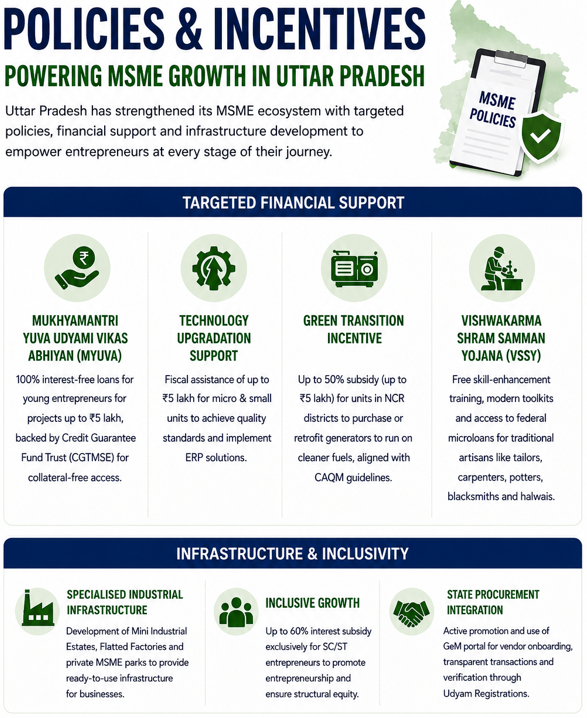
To drive long-term industrial growth, Uttar Pradesh has overhauled its foundational MSME framework to provide targeted, transparent support. A key upgrade is the Mukhyamantri Yuva Udyami Vikas Abhiyan (MYUVA), which tackles early-stage financing by offering young entrepreneurs 100% interest-free loans for projects up to Rs 5 lakh, backed by the Credit Guarantee Fund Trust (CGTMSE) for collateral-free access.
The state also provides fiscal assistance of up to Rs 5 lakh under its technology upgradation initiatives, helping micro and small units meet quality standards and adopt ERP solutions. This is complemented by targeted environmental incentives, including a 50% subsidy (up to ₹5 lakh) for NCR units to purchase or retrofit generators for cleaner fuels, in line with CAQM guidelines. Alongside these, the Vishwakarma Shram Samman Yojana (VSSY) continues to support traditional artisans through free skill training, modern toolkits, and access to federal microloans for trade expansion.
On infrastructure and inclusivity, the state is developing specialised industrial spaces, including Mini Industrial Estates, Flatted Factories, and private MSME parks. To ensure structural equity, enhanced incentives support marginalised communities, including a 60% interest subsidy for SC/ST entrepreneurs.
This ecosystem is further reinforced by state procurement integration, with the government promoting the Government e-Marketplace (GeM) portal to streamline vendor onboarding, ensure transparent transactions, and verify beneficiaries through Udyam Registrations.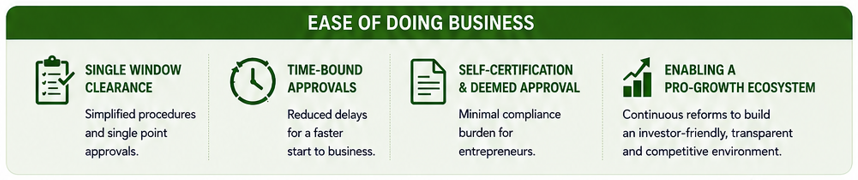
Why Uttar Pradesh offers a competitive advantage, and what lies ahead
The state’s large domestic market, agricultural base, skilled workforce and established manufacturing clusters give businesses a strong operational foundation, while investment in expressways, freight connectivity and logistics is steadily lowering costs and improving access to suppliers, customers and export gateways. Its industrial diversity, spanning engineering, defence, food processing, textiles, leather, electronics and technology services reduces dependence on any single market and creates room for enterprises to collaborate across sectors.
MSMEs today are no longer just working alongside Uttar Pradesh’s large manufacturers, they are becoming a core part of the state’s supply chains, innovation networks and export economy. Initiatives like ODOP continue to strengthen district-level manufacturing, while infrastructure, industrial parks and export policy are opening the door to bigger markets. With the ecosystem expanding across sectors, markets and supply chains, the opportunity for MSMEs in Uttar Pradesh is bigger than ever. For entrepreneurs ready to build, scale and compete, it is time to Think Big. Think U.P.
Sources –
96 Lakh MSMEs base details https://invest.up.gov.in/wp-content/uploads/blogs/14-Blog-MSMEs-in-Uttar-Pradesh.pdf
PLEDGE Scheme Cabinet Approval https://invest.up.gov.in/hi/wp-content/uploads/2023/01/Cabinet_290123.pdf
UP MSME Promotion Policy 2022 Overview https://invest.up.gov.in/uttar-pradesh-micro-small-medium-enterprises-promotion-policy-2022/
ODOP Exports Growth Report https://invest.up.gov.in/wp-content/uploads/2026/01/6-UP_280126.pdf
UP Export Promotion Policy 2025-30 Outline https://invest.up.gov.in/uttar-pradesh-export-promotion-policy-2025-30-2/
MYUVA Scheme Interest-Free Loans https://invest.up.gov.in/wp-content/uploads/2024/10/State_021024.pdf
Aerolloy Technologies UPDIC Node https://invest.up.gov.in/wp-content/uploads/go/pressnews03012025-4.pdf
Nitya Creations Aligarh UPDIC Node https://invest.up.gov.in/wp-content/uploads/2025/10/3-Eng-PressRelease_UPDIC_23Sep_2025_041025.pdf
A R Polymers Ballistic Materials Kanpur https://invest.up.gov.in/wp-content/uploads/2026/03/Eng-PressRelease_UPDIC_12March_2026_230326.pdf
Adhunik Materials and Sciences Kanpur https://invest.up.gov.in/wp-content/uploads/2026/03/Eng-PressRelease_UPDIC_12March_2026_230326.pdf
Amitec Electronics Aligarh UPDIC Node https://invest.up.gov.in/wp-content/uploads/2026/03/Eng-PressRelease_UPDIC_12March_2026_230326.pdf
Chopra Retec Rubber Products MSME Conclave https://invest.up.gov.in/hi/wp-content/uploads/2022/02/press-release-18feb2022-3.pdf
ColorJet Manufacturing Investment GBC https://invest.up.gov.in/wp-content/uploads/2024/02/25-02-2024/preerelesr-220224-17.pdf
Karam Group Industry Association Directory https://invest.up.gov.in/important-industry-associations/
MSME Brochure – https://invest.up.gov.in/wp-content/themes/investup/pdf/2023-sectors/MSME-Sector_25-jan.pdf
ODOP – https://invest.up.gov.in/wp-content/uploads/2024/04/ODOP_140424.pdf
https://invest.up.gov.in/wp-content/uploads/2025/12/7-ODOP_061225.pdf
https://invest.up.gov.in/wp-content/uploads/2026/01/9-One_050126.pdf
https://invest.up.gov.in/wp-content/uploads/2026/01/4-%E0%A4%8F%E0%A4%95_140126.pdf