

Why Uttar Pradesh Is Emerging as India’s Top FDI Destination
Global capital rarely follows promises. It follows markets, infrastructure, governance, and execution. Uttar Pradesh is steadily strengthening all four, and increasingly, that combination is what is drawing global investors to invest in Uttar Pradesh.
For global businesses, an investment decision comes down to one question:
can this destination generate consistent returns over the next two or three decades?
The answer lies in five fundamentals: market opportunity, infrastructure readiness, policy stability, ease of doing business, and long-term growth potential. As global supply chains diversify, Uttar Pradesh is one of the few Indian states offering all five at scale.
A Market Global Businesses Cannot Ignore
Before evaluating incentives, every investment committee asks a simpler question: is there a market large enough to justify long-term investment? For Uttar Pradesh, the answer begins with scale. Home to nearly 250 million people, it is India’s largest consumer market.
Scale alone is not the story. Uttar Pradesh hosts 7 cities with populations exceeding one million, alongside 7 more cities above half a million, giving businesses multiple centres of production, consumption and workforce availability instead of a single metropolitan economy. That spread lowers concentration risk for companies expanding operations.
Geography reinforces the advantage. Uttar Pradesh borders seven Indian states, Uttarakhand, Haryana, Delhi, Rajasthan, Bihar, Jharkhand and Madhya Pradesh, along with an international border with Nepal, placing manufacturers within efficient reach of some of India’s largest consumption centres. A manufacturer here is not simply producing in Uttar Pradesh. It is producing for Uttar Pradesh and for the states around it.
|
Investment Insight |
Infrastructure That Moves Business Faster
Infrastructure is ultimately a measure of how quickly invested capital becomes productive. Every extra day spent moving raw material or waiting for cargo adds to project cost. Uttar Pradesh has spent the past several years building connectivity as the backbone of its industrial economy, not as a standalone public asset.
| Infrastructure Asset | Business Advantage |
| Largest rail network in India | 16,000+ Km rail network |
| 22 Expressways | 10 Operational & 12 Upcoming Expressways |
| 22 Airports | 17 domestic & 5 international Airports |
| Eastern (57%) & Western (8.5%) Dedicated Freight Corridors, intersecting at Dadri | Efficient freight movement to ports, linked with the Defence Industrial Corridor |
These industrial corridors in Uttar Pradesh directly influence transportation cost, inventory cycles and supply chain resilience, the factors that determine how competitive a manufacturing operation really is.
| Investment Insight Infrastructure is no longer judged only by the assets a state has built. It is judged by the cost and time it saves businesses every day. |
An Industrial Ecosystem Built for Immediate Expansion
Global investors increasingly avoid locations where they must acquire vacant land and spend years building supporting infrastructure. They prefer ecosystems where utilities, connectivity and regulatory support already exist. Uttar Pradesh offers more than 75,000 acres of GIS-enabled, investment-ready industrial land, organised into sector-specific parks rather than generic industrial estates.
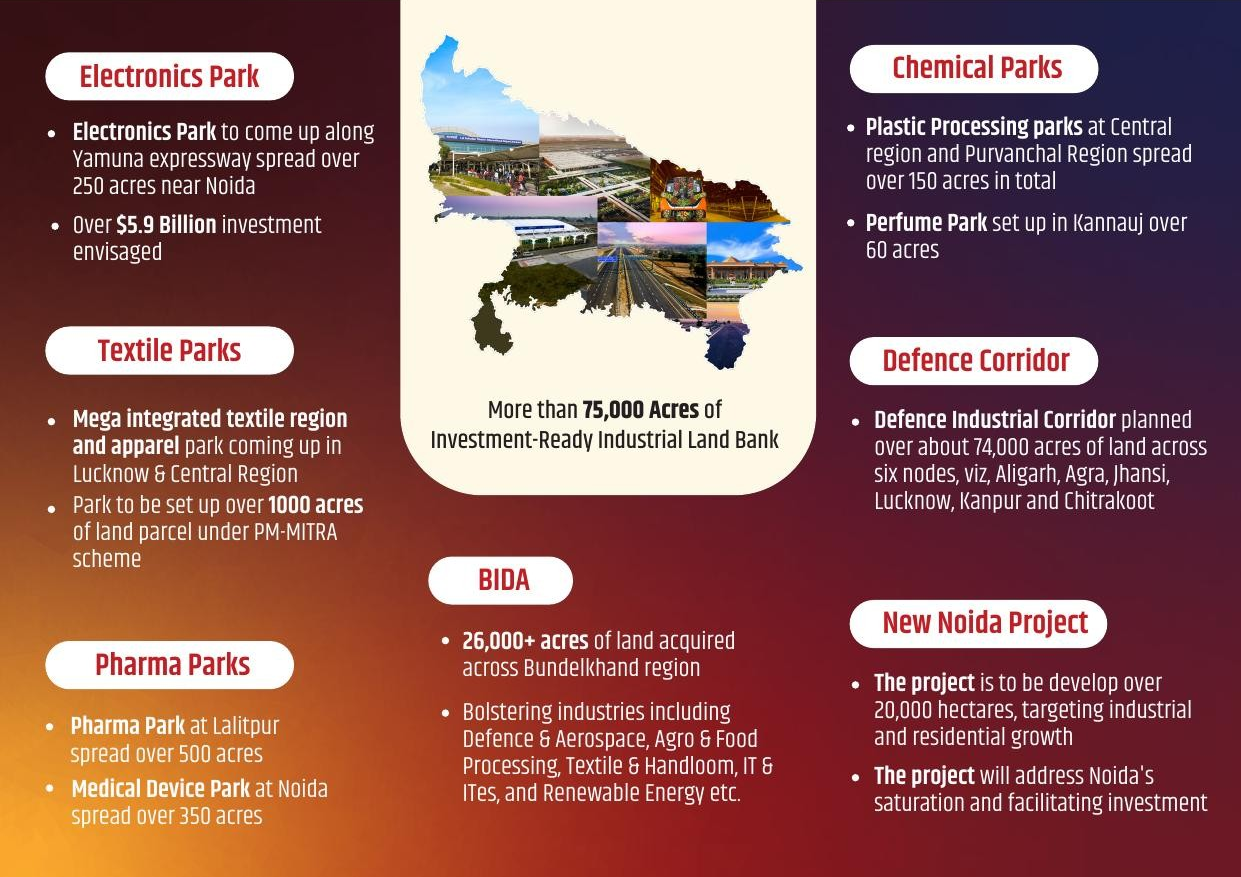
Uttar Pradesh’s investment-ready industrial land bank..
Policies That Compete for Global Capital
Infrastructure earns investor interest. Policy decides whether the investment is financially viable. Uttar Pradesh does not rely on one industrial policy. It runs an ecosystem of 36+ sector-specific policies, covering electronics, semiconductors, EVs, food processing, defence manufacturing, data centres and Global Capability Centres, among others, including the Plug and Play Industrial Shed Policy (DBFOT Model) 2026, the Uttar Pradesh Export Promotion Policy 2025–30, the UP Semiconductor Policy 2024, the UP Green Hydrogen Policy 2024 and the UP GCC Policy 2024.
The FDI/FCI, Fortune Global 500 & Fortune India 500 Investment Promotion Policy 2023 is one of the first policies in India built specifically to attract foreign capital investment, and it is central to any case for FDI in Uttar Pradesh. It applies to:
- Manufacturing and service projects with Foreign Capital Investment (FCI) of ₹100 crore or more.
- Companies from the Fortune Global 500 or Fortune India 500 lists investing more than ₹100 crore, subject to a negative list covering tobacco, alcohol, iron & steel, cement, beverages and logistics.
Alongside it, the Industrial Investment & Employment Promotion Policy (IIEPP) 2022 provides the state’s broader industrial incentive framework, capital subsidies, SGST reimbursement, PLI top-ups and employment-linked support.
What the Incentives Actually Solve
| Investment Lever | Key Incentive |
| Front-end Land Support | Front-end land subsidy allotment at 25% in Paschimanchal & Madhyanchal and 20% in Bundelkhand & Purvanchal, with the balance reimbursed to Industrial Development Authorities by the State. |
| Capital Support | 25%–35% Capital Subsidy on Eligible Capital Investment (ECI), disbursed over seven annual instalments, with an annual ceiling of ₹100 crore. |
| Tax Incentives | 100% Net SGST Reimbursement (up to the eligible investment limit over 10 years) |
| Transaction Cost Savings | 100% exemption/reimbursement of Stamp Duty and Registration Fees. |
| Lower Operating Costs | 100% exemption from Electricity Duty for five years. |
| Skilling Support | Reimbursement of workforce training costs of up to ₹5,000/ person per month for up to 500 employees over five years. |
| Innovation and R&D Support | 25% R&D support subsidy up to ₹10 crore or Centres of Excellence (50% grant up to ₹10 crore), along with 75% reimbursement of patent registration expenses. |
| Green Manufacturing | 50% capital subsidy, up to ₹2.5 crore, for establishing Effluent Treatment Plants (ETPs). |
Nivesh Mitra 3.0: Redefining Ease of Doing Business
Most states describe their approval systems as single-window clearance. Nivesh Mitra 3.0 goes further: it is a single digital ecosystem, integrating approvals, land discovery, incentives and grievance redressal into one interface. It builds on Nivesh Mitra 2.0, which processed 22 lakh+ applications at a 97.3% disposal and satisfaction rate.
| Reform | Why It Matters |
| 530+ services consolidated into fewer than 225 | Simplifies regulatory interactions for investors. |
| ~25% fewer application fields | Reduces the time and effort required to apply. |
| 15% reduction in document requirements | Minimises paperwork and compliance complexity. |
| ~20% fewer procedural steps | Accelerates approvals and shortens project timelines. |
| 100% SLA-driven service delivery | Brings transparency, predictable timelines and greater administrative accountability. |
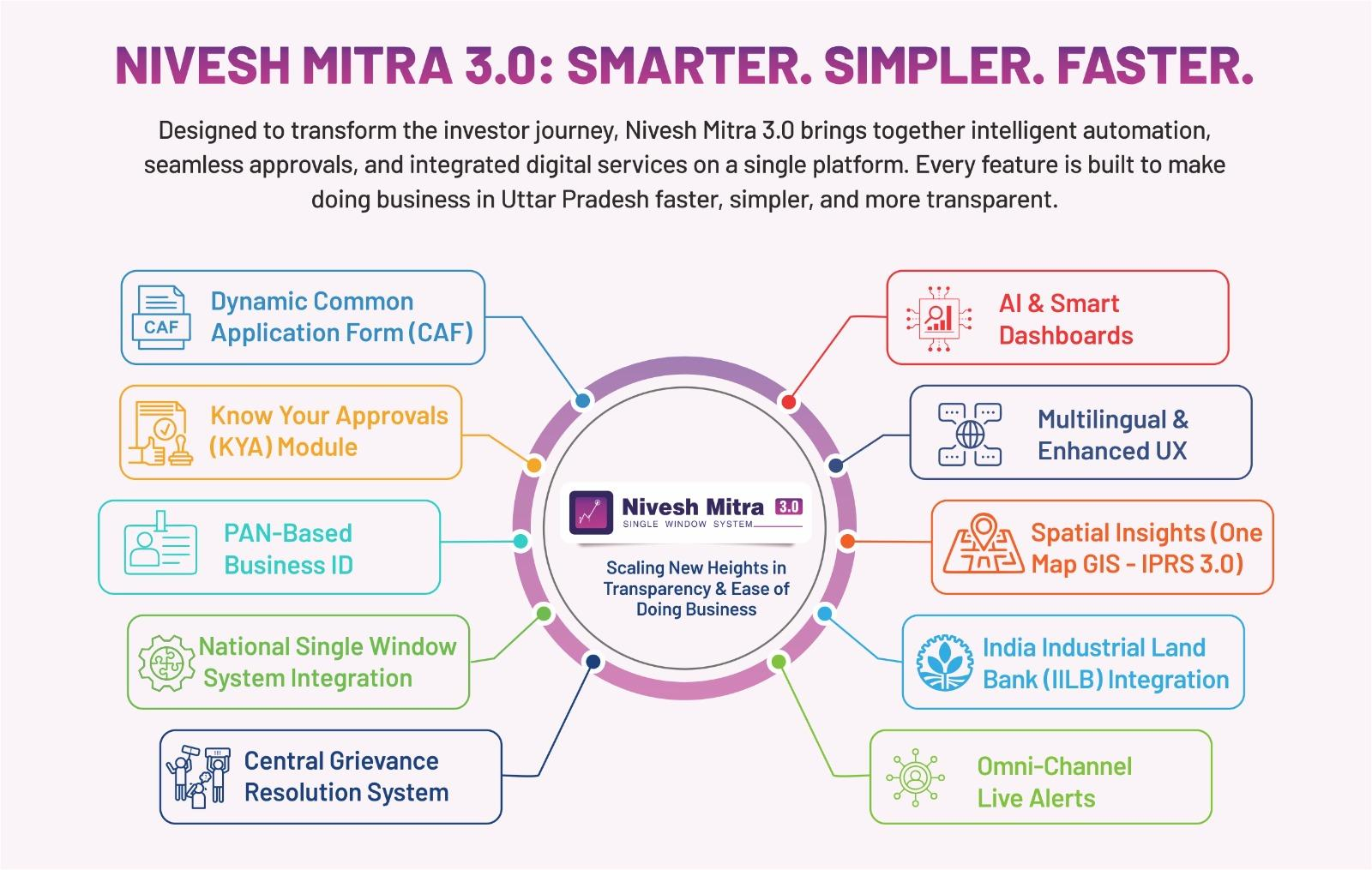
The platform is backed by 434 documented reforms across 23 priority areas and 71 sub-priority areas, and Uttar Pradesh is ranked 1st in India’s Deregulation exercise with 100% implementation across all priority areas. Since 2017, when the state ranked 14th on ease of doing business, this sustained programme has taken it to Top Achiever State status in BRAP 2022 and 2024.
Governance That Builds Investor Confidence
Infrastructure creates capacity and policy improves project viability, but governance decides whether both actually translate into investment. Uttar Pradesh’s governance metrics show a state that has institutionalised reform rather than announced it once:
| Recognition | What It Signifies |
| LEADS 2021 – 6th Rank (Top Improver) | Strong progress in logistics efficiency and supply chain competitiveness. |
| Good Governance Index 2021 – 1st Rank | Leadership in governance, administrative efficiency and public service delivery. |
| Export Preparedness Index 2021 – 2nd Rank (Landlocked States)* | Growing export competitiveness despite being a landlocked state. |
| LEADS 2022 – Achiever State | Continued improvement in logistics infrastructure and ease of cargo movement. |
| BRAP 2022 – Achiever State | Recognition for implementing business-friendly regulatory reforms. |
| LEADS 2023 – Achiever State | Sustained performance in logistics and multimodal connectivity. |
| LEADS 2024 – Achiever State | Continued strengthening of the state’s logistics ecosystem. |
| BRAP 2024 – Top Achiever State | National recognition for excellence in Ease of Doing Business reforms and investor facilitation. |
| LEADS 2025 – Exemplar State | Highest level of recognition for creating a robust, future-ready logistics ecosystem. |
Global Companies Are Already Choosing Uttar Pradesh
Every investment destination makes a promise. The more important question is whether the market believes it. Uttar Pradesh’s answer lies in the range of companies that have already committed, spread across electronics, automobiles, IT and GCCs, food and FMCG, conglomerates, aviation and logistics, and more.
| Sector | Industry Presence |
| Electronics & Semiconductors | Samsung, Renesas, LG, Philips, Fujitsu, Cadence, Hitachi |
| Automobiles & Mobility | Honda, Yamaha, Denso, Delphi, Motherson Sumi Systems |
| Technology, IT & GCCs | Microsoft, IBM, HCLTech, Cisco, Amazon, Uber, Sify, MAQ Software |
| Data Centres | ST Telemedia Global Data Centres |
| Food Processing & FMCG | PepsiCo, Cargill, McCain, Jubilant FoodWorks, Kellogg’s, Grupo Bimbo, AB Mauri, Agristo, Unilever |
| Indian Conglomerates | Tata Group, Reliance Industries, Aditya Birla Group, Godrej, ITC Limited |
| Aviation & Logistics | Air India SATS, Flughafen Zürich, DP World |
| Defence & Aerospace | Thales |
| Advanced Manufacturing & Consumer Goods | Haier, Panasonic, NTT DATA, Havells, LuLu Group, DBS, Senko Advance, JM |

Global and Indian brands present in Uttar Pradesh.
The Uttar Pradesh Advantage
Foreign Direct Investment is ultimately a measure of confidence in markets, in infrastructure, in institutions and in a government’s ability to support businesses over the long term. Uttar Pradesh has spent the past several years strengthening each of these pillars at the same time.
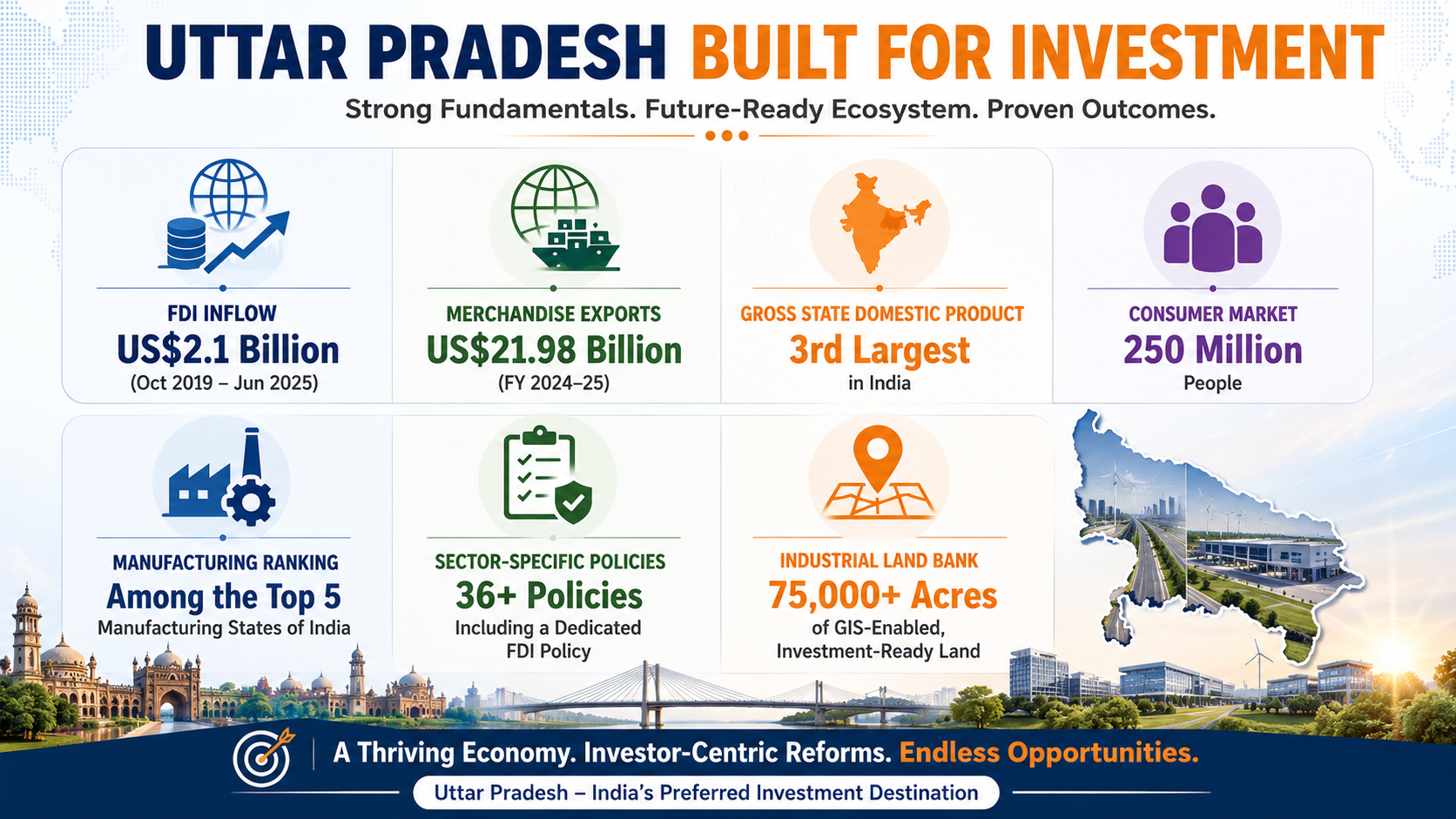
A 250-million-strong consumer market. India’s third-largest state economy. US$21.98 billion in merchandise exports. Multimodal infrastructure and industrial corridors that connect East, West and Central India. 75,000+ acres of investment-ready industrial land. 36+ sector-specific policies, anchored by a dedicated FDI/FCI Investment Promotion Policy.
A digital investment ecosystem in Nivesh Mitra 3.0. Together, these form a value proposition that goes well beyond fiscal incentives. Each reform reinforces the next: infrastructure accelerates manufacturing, industrial ecosystems reduce project timelines, policy improves investment economics and digital governance simplifies approvals.
As global companies continue to diversify supply chains, competition between states will increasingly be decided by execution rather than promise. For investors evaluating India’s next phase of growth, Uttar Pradesh is steadily positioning itself not just as a large market but as one of the country’s most complete investment ecosystems and a state built on the case to invest in Uttar Pradesh today.