

Uttar Pradesh’s Vision for Becoming India’s Top Investment Hub
Investment in U.P. is being driven by world-class infrastructure, business-friendly governance, industrial policies, manufacturing hubs, defence corridors and digital ecosystems, showcasing how Uttar Pradesh is emerging as India’s preferred investment destination.
India’s economic story is increasingly being shaped not only by national reforms but also by the ability of individual states to create ecosystem where businesses can thrive. As global companies diversify supply chains and look for cost-efficient production bases, competition among states to attract investment has intensified. Uttar Pradesh (U.P.) has undergone one of the most significant economic transformations, evolving from a landlocked state into a land-linked investment destination under the leadership of Hon’ble Chief Minister Yogi Adityanath.
Amid this changing landscape, investment in U.P. has emerged as one of India’s most compelling growth stories. Once known primarily for its agricultural base, Uttar Pradesh has steadily transformed into a state where infrastructure, governance reforms and sectoral policies are converging into a comprehensive investment ecosystem by supporting industries from manufacturing and logistics to defence, healthcare and renewable energy.
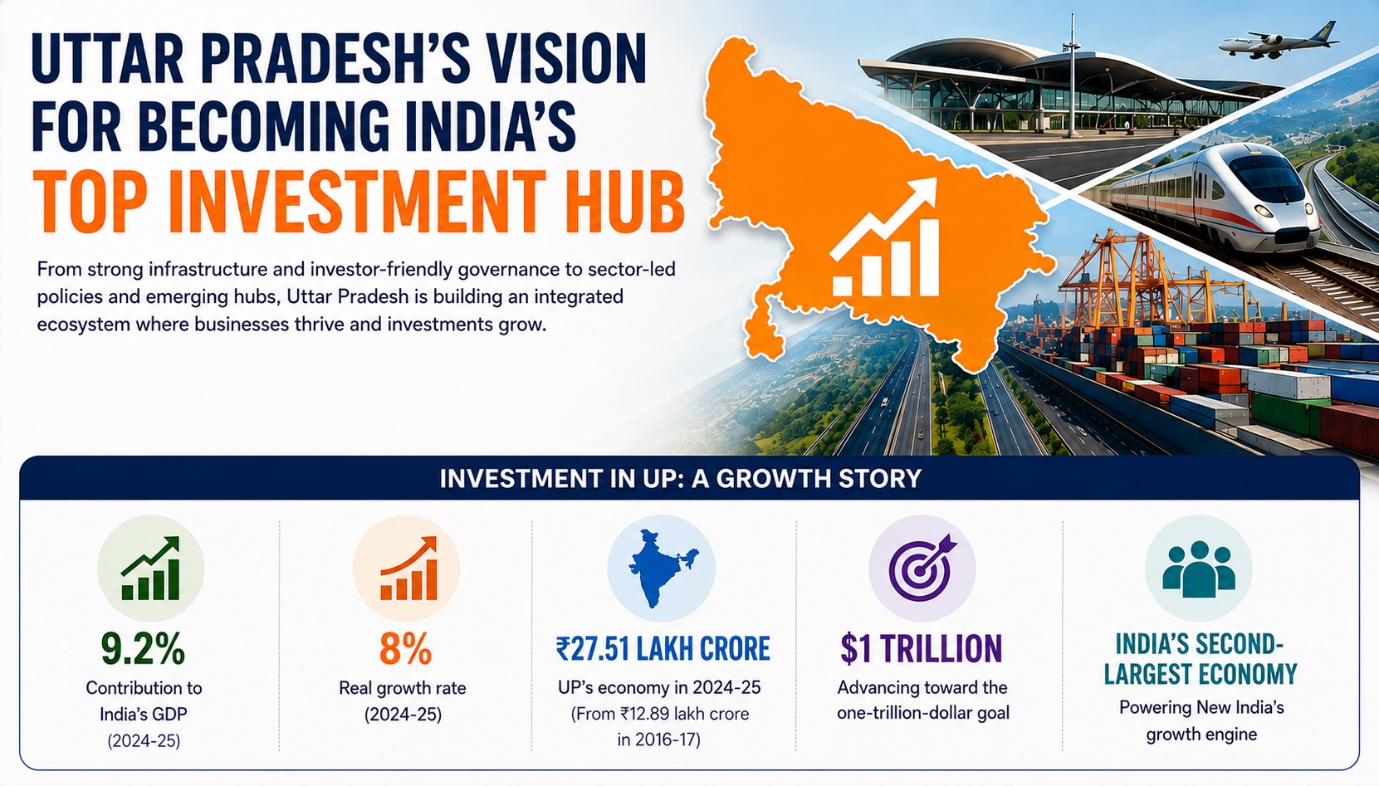
Building the foundation for investment in U.P.
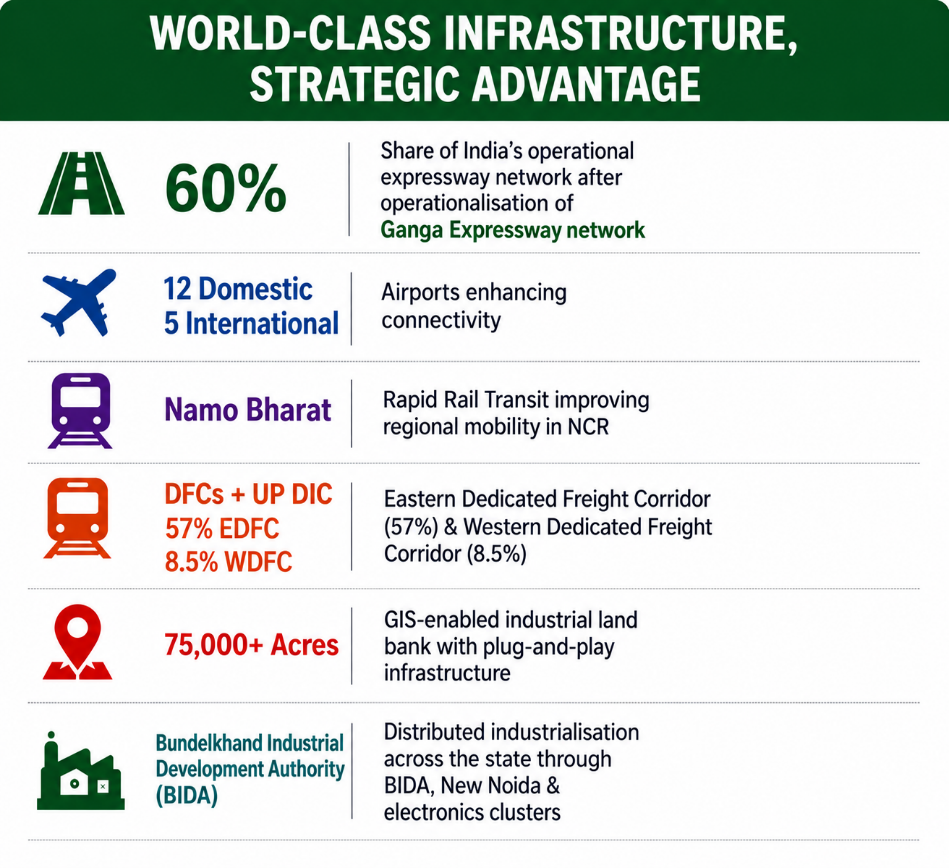
Infrastructure and connectivity are the basic foundation block one needs to work on to amplify your current and Upcoming business. Strategically located in northern India, U.P. offers direct access to eastern, western and central markets. Its rapidly expanding transport network has strengthened this advantage by reducing transit times and improving supply chain reliability across sectors.
U.P. now accounts for nearly 60% of India’s operational expressway network following the operationalisation of Ganga Expressway. Seventeen domestic and five international airports are steadily enhancing connectivity, while the operational Namo Bharat Rapid Rail Transit System has strengthened regional mobility within the National Capital Region (NCR).
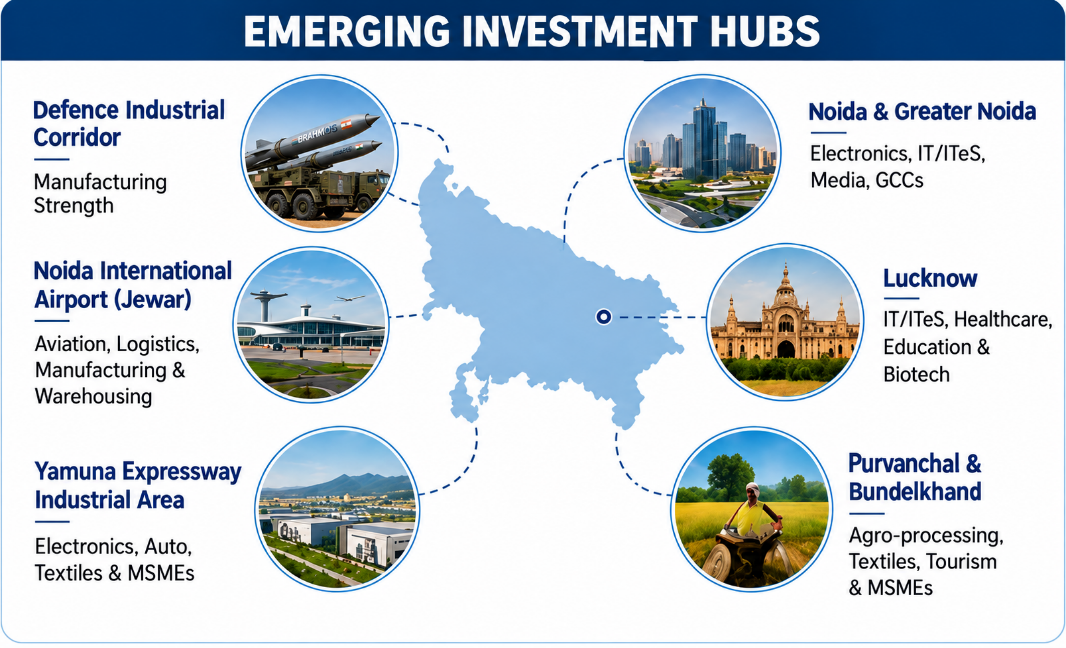
Expanding infrastructure and connectivity are strengthening links across regions and creating a more integrated ecosystem for industry, logistics and investment. As these networks continue to develop, new opportunities will open up and thrive across the state, supporting the growth of businesses and emerging investment hubs.
Noida International Airport at Jewar is positioned to become one of India’s largest aviation and logistics gateways. Designed as an integrated Aerotropolis, the airport features an Rs 1,800 crore Maintenance, Repair, and Overhaul (MRO) and Cargo Hub and is structured to accommodate a massive 50 million passenger traffic capacity. The airport would further facilitate and help in catalysing manufacturing, warehousing, fabrication parks and data-centre clusters across western U.P.
Moreover, land availability has been addressed through a GIS-enabled industrial land bank spanning more than 75,000 acres, combined with plug-and-play infrastructure that shortens project timelines.
U.P. facilitates business friendly environment
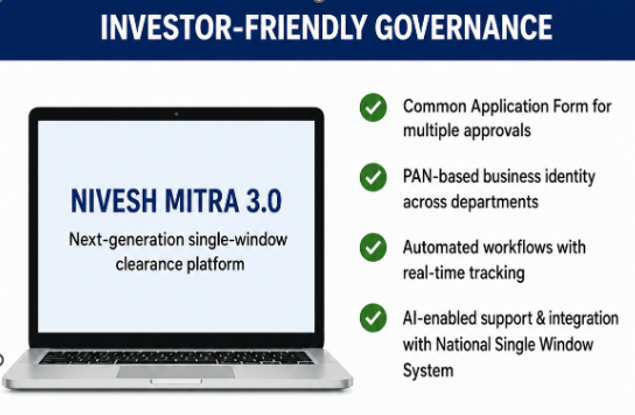
Infrastructure alone does not attract investment; businesses also need predictable regulation and efficient administration. Over the past several years, U.P. has overhauled its investment facilitation framework around this principle.
The centrepiece is Nivesh Mitra 3.0, the state’s next-generation single-window clearance platform, which integrates hundreds of government services across departments. A Common Application Form allows businesses to apply for multiple approvals through one submission. The platform is AI-enabled support and integrated with the National Single Window System that lets investors monitor both central and state approvals from one interface. These initiatives have significantly strengthened the state’s Ease of Doing Business, enabling investors to establish and expand operations with greater speed, transparency and confidence. The results have translated into national recognition, with Uttar Pradesh emerging as a “Top Achiever” in the Business Reforms Action Plan (BRAP) in 2022 & 2024.
How sector-led policies are accelerating investment in U.P.
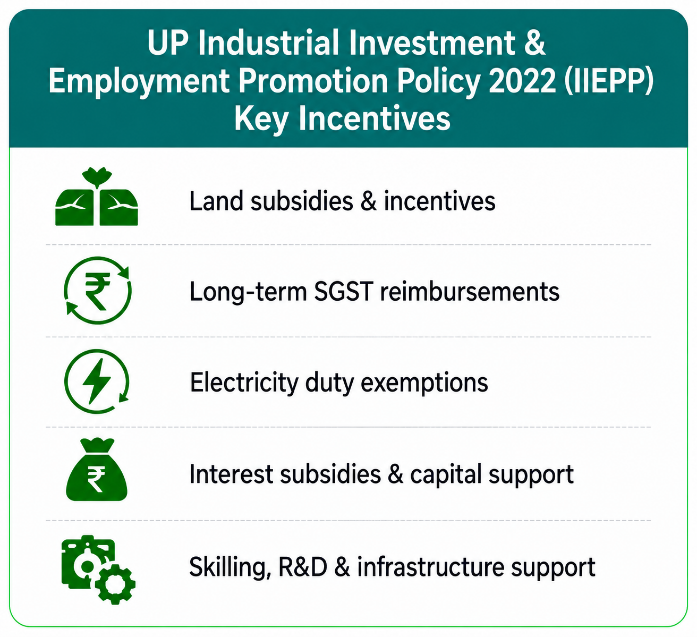
Rather than a one-size-fits-all approach, U.P. now offers more than 36+ sector-specific policies covering everything from semiconductors and electric mobility to green hydrogen, data centres and Global Capability Centres (GCCs).
At the core is the U.P. Industrial Investment and Employment Promotion Policy 2022, complemented by dedicated frameworks for Foreign Direct Investment (FDI) and Fortune 500 companies, electronics, semiconductors, aerospace and defence, pharmaceuticals, warehousing, EV manufacturing, textiles and exports. The FDI and Fortune 500 policy illustrates the approach: it combines front-end land subsidies, long-term SGST reimbursements, electricity duty exemptions and capital support to lower the cost of establishing large-scale operations which removes one of the biggest barriers global manufacturers face when entering a new market.
Creating a business-friendly environment for investment in U.P.
A defining feature of the Uttar Pradesh investment ecosystem is the shift from promoting standalone industrial units to building specialised clusters. A prime illustration of this cluster-based approach is the Yamuna Expressway Industrial Development Authority’s (YEIDA) Upcoming 206-acre Electronics Manufacturing Cluster. Located in Sector 10 and strategically positioned near the Noida International Airport.
This further strengthens Uttar Pradesh’s manufacturing ecosystem, with global companies such as Samsung, Vivo, and Dixon Technologies continuing to expand their operations across the state. Their growing presence reflects Uttar Pradesh’s emergence as a major destination for electronics and advanced manufacturing. The automotive sector is also expanding in parallel, with Ashok Leyland strengthening its presence in Lucknow through its commercial vehicle and electric bus manufacturing operations.
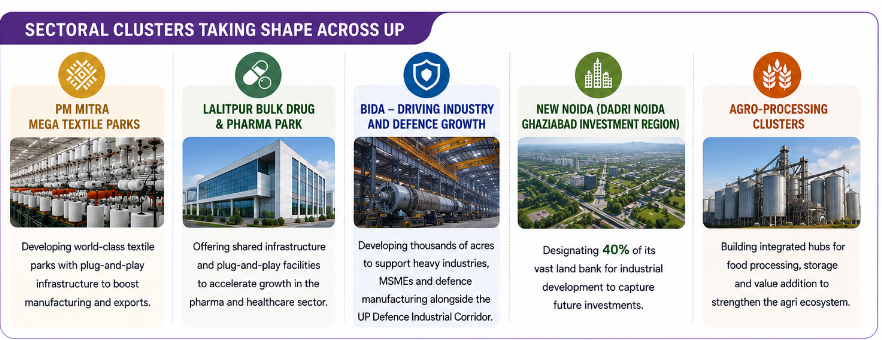
Beyond electronics and automotive, dedicated sector-specific clusters are taking shape across the state. The state government is actively promoting PM MITRA mega textile parks and the Lalitpur Bulk Drug and Pharma Park, which offers shared infrastructure and plug-and-play facilities for the healthcare sector. The Integrated Industrial Township at Greater Noida is also emerging as a planned industrial hub, offering modern infrastructure and an ecosystem designed to support manufacturing and investment. Furthermore, the Bundelkhand Industrial Development Authority (BIDA) and the Dadri Noida Ghaziabad Investment Region (New Noida) project are extending this cluster-based model. BIDA is developing thousands of acres to support heavy industries, MSMEs, and defence manufacturing alongside the U.P. Defence Industrial Corridor, while New Noida is strategically designating 40% of its vast land bank for industrial development to capture future investments.
Driving the digital economy through data centres and GCC
U.P. Global Capability Centres (GCC) Policy 2024
| Feature | Policy Details |
| Capital Incentive | Up to 25% capital subsidy on eligible fixed capital investments |
| Operational Subsidy | Up to 20% operational subsidy for lease costs, power, bandwidth and cloud infrastructure expenses |
| Payroll Assistance | Reimburses Up to ₹1.8 lakh per employee per year for hiring local U.P.-domicile talent |
| Talent Retention | Up to ₹20,000 fresher recruitment subsidy for every U.P.-domicile graduate hired directly from state institutions. |
U.P. is building a strong digital economy. Noida has evolved into a centre for engineering research and product development. In 2024, the state introduced a dedicated Global Capability Centre’s (GCC) Policy offering operational subsidies, payroll assistance, and capital incentives to create high-quality jobs closer to home for northern engineering graduates.
Uttar Pradesh Data Centre Policy 2026
| Feature | Policy Details |
| Investment target | Targets Up to ₹2 Lakh crore in private and institutional investment |
| Categorisation | Covers Hyper-scale Data Centre Parks (min. 40MW) and Local Edge Data Centres |
| Booster Incentives | Financial support for Tier III/IV certifications and deployment of AI compute hardware |
| Green Mandate | Green incentives linked to PUE and renewable energy adoption |
| Infrastructure Support | Higher purchasable FAR, assured infrastructure and ESMA protection |
Building on this, the U.P. Data Centre Policy 2026 targets Rs 2 Lakh Crore in new investments and an additional 2GW+ capacity by emphasising green, AI-ready infrastructure. To attract global operators, the policy provides booster incentives for Tier III/IV certifications, and green operations tied to low Power Usage Effectiveness (PUE) and a 50% renewable energy share by 2030.
Scaling Uttar Pradesh’s Defence Industrial Corridor
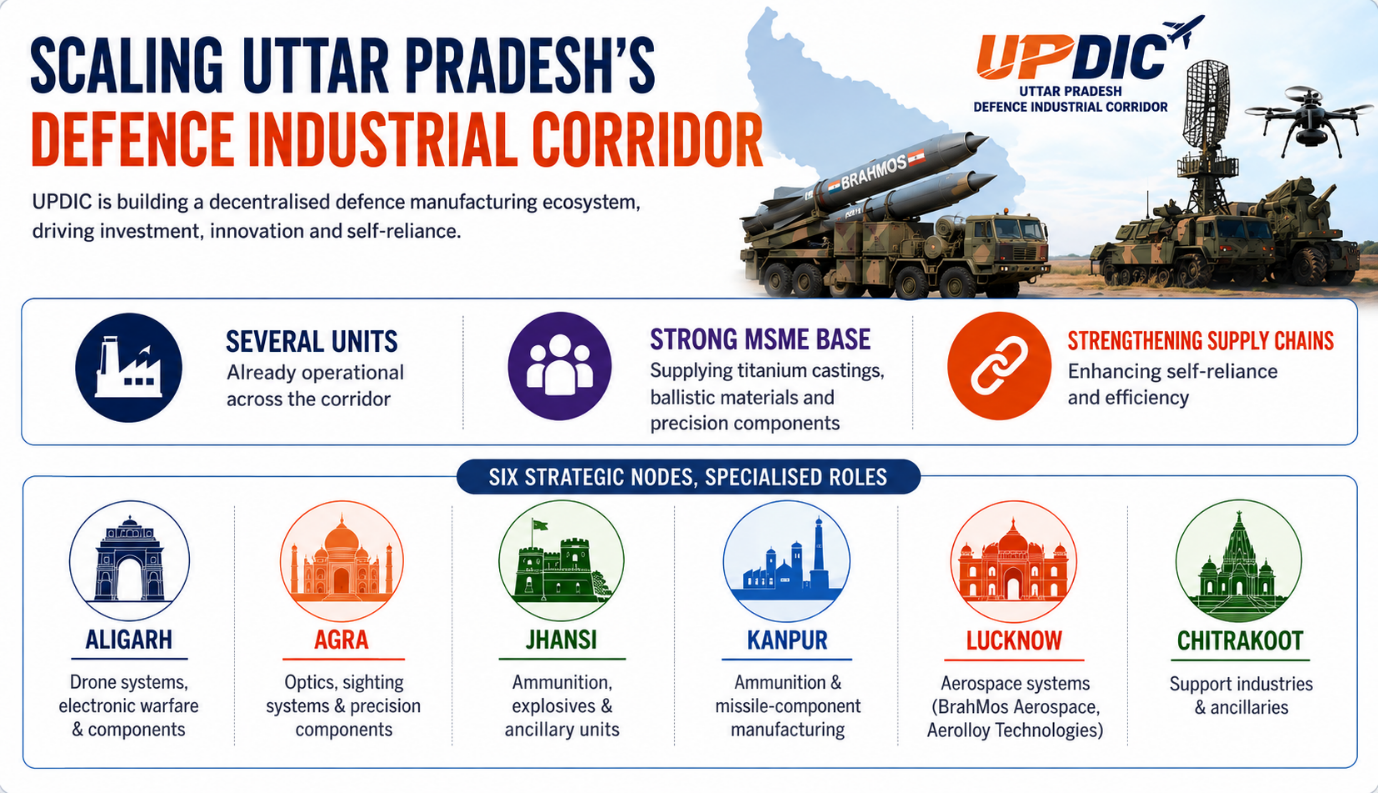
The Uttar Pradesh Defence Industrial Corridor (UPDIC) is among the state’s most strategically significant initiatives. Spanning six nodes — Aligarh, Agra, Jhansi, Kanpur, Lucknow and Chitrakoot — the corridor decentralises manufacturing, assigning each location a specialised role within the defence supply chain.
The results of this design are now visible on the ground. UPDIC has drawn huge investment proposals with nine units already operational and several more moving from land allotment to production.
The corridor also builds on the state’s established defence manufacturing base, including the presence of Defence Public Sector Undertakings (DPSUs), creating a stronger foundation for private industry and ancillary suppliers.
Kanpur holds the largest committed investment, anchored by Adani Defence & Aerospace’s ammunition and missile-component facilities, while Lucknow has grown into the corridor’s aerospace nucleus, home to BrahMos Aerospace’s missile-assembly unit and Aerolloy Technologies’ titanium-casting operations.
Aligarh has carved out a niche in drone and electronic-warfare manufacturing, led by firms such as Ancor Research Labs and Amitec Electronics, and Jhansi has been designated the corridor’s Centre for Ammunition and Explosives, hosting sixteen companies producing propellants, explosives and mobile infantry platforms. Together, these nodes are converting a six-city blueprint into a functioning, self-reinforcing defence manufacturing base.
A growing base of MSMEs supplying titanium castings, ballistic materials and precision components is strengthening domestic supply chains across the corridor, making the process much smoother and more efficient.
Strengthening healthcare and pharma in Uttar Pradesh
Healthcare has become another strategic pillar, anchored by the U.P. Pharmaceutical and Medical Device Industry Policy 2023. Two flagship projects lead this effort: the roughly 1,472-acre Lalitpur Bulk Drug Pharma Park, being developed as a large-scale hub for active pharmaceutical ingredients, and the YEIDA Medical Device Park near the Noida airport. Research institutions including the Central Drug Research Institute and the MedTech Centre of Excellence at IIT Kanpur add a scientific foundation to this manufacturing base.
Global partnerships and investor confidence
Growing investor confidence is reflected in the scale of commitments from companies such as Samsung, Vivo, Dixon, Tata Consultancy Services, Ashok Leyland and Adani Defence & Aerospace, alongside international outreach that has drawn investment interest from countries including Singapore and Japan across industrial parks, logistics, data centres and renewable energy. Meanwhile, the state also secured Rs 1.5 lakh crore in investment through MoUs with Singapore and Japan covering sectors like infrastructure, digital ecosystems, and advanced manufacturing.
The story of investment in U.P. is no longer defined solely by incentives or individual projects, it is increasingly about an integrated ecosystem where connectivity, governance, industrial policy and skilled talent reinforce one another. From Noida’s digital economy and Kanpur’s advanced manufacturing to Bundelkhand’s industrial expansion and Lucknow’s aerospace ecosystem, the state is building multiple centres of growth that support one another rather than compete for the same investment. For businesses looking at their next big opportunity, the message is simple: Think Big. Think U.P.
Sources –
1. Samsung (₹4,825 crore investment): https://invest.up.gov.in/indias-esdm-sector-amplifying-growth-in-a-digital-era/
2. Dixon Technologies (₹256 crore facility): “ESDM Manufacturing Sector” investment brochure. On page 13, it details that Padget Electronics (a subsidiary of Dixon) established a new manufacturing facility in Noida with an investment of ₹256 crore.
https://invest.up.gov.in/wp-content/uploads/2024/05/ESDM-Manufacturing-Sector_270524.pdf
3. Ashok Leyland (₹1,000 crore operational plant):
https://invest.up.gov.in/wp-content/uploads/2026/01/5-Ashok_100126.pdf
4. YEIDA & Centre Investment: https://invest.up.gov.in/wp-content/uploads/2025/04/1-Noida_300425.pdf
5. Lalitpur 1,472 Acre Survey Details (News Archive): https://invest.up.gov.in/wp-content/uploads/2023/12/investUP-1512-10.pdf
6. UPDIC Investments detail: https://invest.up.gov.in/wp-content/uploads/2026/03/Eng-PressRelease_UPDIC_12March_2026_230326.pdf